Bert Alexander Petzold
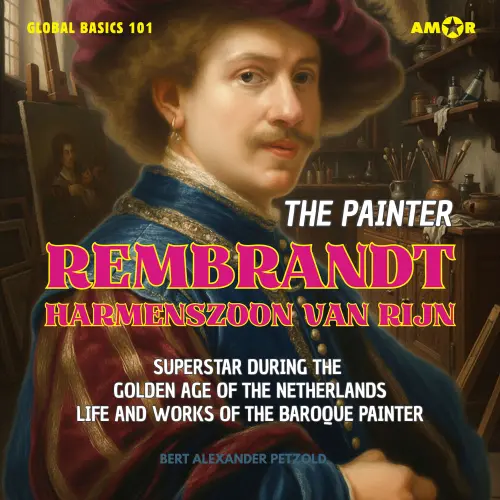
The Painter Rembrandt Harmenszoon van Rijn - Superstar during the Golden Age of the Netherlands - Global Basics 101 - Your Series for Modern Knowledge, Book 3 Life and Works of ...
ungekürzt
1 hour 13 minutes




Some articles contain affiliate links (marked with an asterisk *). If you click on these links and purchase products, we will receive a small commission at no extra cost to you. Your support helps to keep this site running and to continue creating useful content. Thank you for your support!
Anyone who looks at Rembrandt van Rijn sees more than Baroque painting: light rising out of darkness, faces charged with inner life, pictures that still feel like a conversation. What is it about him that makes works in the Rembrandt House Museum and in the world's great collections hold viewers spellbound - from school lessons to university seminars, in Amsterdam and far beyond?
This non-fiction book invites you on a fact-rich cultural journey through the Dutch Golden Age. In clear, vivid prose it turns biography and key works into a 'school of seeing'. You learn how Rembrandt steers light and composition, how he builds psychological presence, and how to recognise self-portrait, history painting, portraiture and etching as distinct ways of thinking with images. Even if 'Die Nachtwache' is familiar, its artistic logic becomes newly intelligible.
Born in Leiden on 15 July 1606, Rembrandt grew up in a respectable middle-class household that valued education and ambition. After Latin school he trained with Jacob Isaacsz. van Swanenburgh and then with the Amsterdam history painter Pieter Lastman. Back in Leiden he shared a studio with Jan Lievens and soon taught his first pupil, Gerrit Dou.
Moving to Amsterdam in 1632, he achieved rapid fame, commissions and prosperity. His marriage to Saskia van Uylenburgh coincided with masterpieces such as 'Die Anatomie des Dr. Nicolaes Tulp', 'Belshazzars Gastmahl' and the world-famous 'Die Nachtwache'. Later, Saskia's death, his partnership with Hendrickje Stoffels and mounting debts led to bankruptcy in the 1650s. Out of crisis came works of fierce intensity: 'Christus heilend die Kranken' (the 'Hundertguldenblatt'), 'Die drei Kreuze', 'Ecce Homo' and 'Aristoteles mit der Büste des Homer'. Here, shadows do not conceal; they reveal.
In his final years he painted with a new warmth and dignity - 'Die Staalmeesters' and 'Die Judenbraut' - while modern research continues to revise attributions as new works surface and others return to his pupils.
Written by Bert Alexander Petzold, the book is ideal for GCSE and A-level revision as well as university study. It uses Rembrandt's life and greatest works as a practical guide to looking, so you can not only recognise his paintings but truly understand them. Secure your copy and let Rembrandt 's pictures become a lasting guide to how images work.
This non-fiction book invites you on a fact-rich cultural journey through the Dutch Golden Age. In clear, vivid prose it turns biography and key works into a 'school of seeing'. You learn how Rembrandt steers light and composition, how he builds psychological presence, and how to recognise self-portrait, history painting, portraiture and etching as distinct ways of thinking with images. Even if 'Die Nachtwache' is familiar, its artistic logic becomes newly intelligible.
Born in Leiden on 15 July 1606, Rembrandt grew up in a respectable middle-class household that valued education and ambition. After Latin school he trained with Jacob Isaacsz. van Swanenburgh and then with the Amsterdam history painter Pieter Lastman. Back in Leiden he shared a studio with Jan Lievens and soon taught his first pupil, Gerrit Dou.
Moving to Amsterdam in 1632, he achieved rapid fame, commissions and prosperity. His marriage to Saskia van Uylenburgh coincided with masterpieces such as 'Die Anatomie des Dr. Nicolaes Tulp', 'Belshazzars Gastmahl' and the world-famous 'Die Nachtwache'. Later, Saskia's death, his partnership with Hendrickje Stoffels and mounting debts led to bankruptcy in the 1650s. Out of crisis came works of fierce intensity: 'Christus heilend die Kranken' (the 'Hundertguldenblatt'), 'Die drei Kreuze', 'Ecce Homo' and 'Aristoteles mit der Büste des Homer'. Here, shadows do not conceal; they reveal.
In his final years he painted with a new warmth and dignity - 'Die Staalmeesters' and 'Die Judenbraut' - while modern research continues to revise attributions as new works surface and others return to his pupils.
Written by Bert Alexander Petzold, the book is ideal for GCSE and A-level revision as well as university study. It uses Rembrandt's life and greatest works as a practical guide to looking, so you can not only recognise his paintings but truly understand them. Secure your copy and let Rembrandt 's pictures become a lasting guide to how images work.
Lismio